
Remember when Caribou were lost to global warming?
Here on the endlessly rolling and tussocky terrain of northwest Canada, where man has hunted caribou since the Stone Age, the vast antlered herds are fast growing thin. And it’s not just here. Across the tundra 1,500 kilometers (1,000 miles) to the east, Canada’s Beverly herd, numbering more than 200,000 a decade ago, can barely be found today.
…
From wildlife spectacle to wildlife mystery, the decline of the caribou — called reindeer in the Eurasian Arctic — has biologists searching for clues, and finding them. They believe the insidious impact of climate change, its tipping of natural balances and disruption of feeding habits, is decimating a species that has long numbered in the millions and supported human life in Earth’s most inhuman climate.
Stories like that were everywhere, all based on the fact that the huge Beverly herd didn’t show up at its breeding grounds as expected. Scientists rushed to blame global warming, even as the locals told them the herd hadn’t gone away, but had simply moved. But what do pesky elders know when there’s global warming funding to be had?
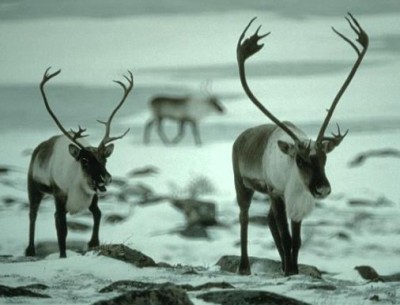
a pesky caribou and friend
Turns out, the elders know quite a bit about caribou:
A vast herd of northern caribou that scientists feared had vanished from the face of the Earth has been found, safe and sound — pretty much where aboriginal elders said it would be.
Pesky nature didn’t need saving from a trace gas after all. I said this before, and I’ll say it again now:
If there is another extinction event coming, rest assured that the only reason to blame mankind is because someone, somewhere needs a study funded.
[ad#insert-large]


[...] like there’s a trend, or [...]
Missing:-50 million climate refugee’s,200,000 caribou and a pack of polar bears REWARD a blank cheque from the U.N. underwritten by tax paying mushrooms.
Not only caribou, but moose:
“For years, Refuge visitors and staff noticed that moose came into the mountain valleys in the eastern portion of the Arctic Refuge each fall, and disappeared again each spring. Where the moose spent the summer was a mystery. Meanwhile, the Vuntut Gwitchin Indians of Old Crow village in northern Canada had a mystery of their own. They knew that moose came to Old Crow Flats in late spring, but wondered where they disappeared to in the winters.”
http://arctic.fws.gov/moosesdy.htm
Reminds me of a story I read a few years ago. A team of archaeologists was sure they’d located the site of a “missing” (previously undiscovered) Roman fort in the north of England. After an extensive aerial survey indicated a rectangular platform of the right size, they visited the farm on which it was located, and introduced themselves to the farmer. He said “I suppose you’ve come to see the fort? I’ll show you where it is. I’ve got loads of tiles and pottery in my barn”. A little local enquiry saves a lot of work.
Don’t worry, DB. Some assclown at COP17 will still claim they are dead.
The Carbon Trade Show must go on.